Earnest motivational quotes on clothing read like unskippable corporate presentations, which is why hyper-arrogant satire easily took their place. Modern internet culture thrives on pure cheekiness instead of rehearsed grit. Slapping an impossibly bloated ego onto cotton turns everyday street style into a running joke against self-seriousness.
People gravitate toward ironic slogan t shirts because declaring unearned godhood is fundamentally funnier than trying to look productive. Strolling through a grocery aisle while wearing a proclamation of absolute personal supremacy makes ordinary errands feel like a mock red carpet.
Swagger built on zero credentials disarms the room instantly. Arrogance this loud leaves no room for genuine conceit, trading desperate validation for breezy, deliberate absurdity.
Sincere Hustle Quotes Ran Out of Steam
The cultural appetite for relentless self-optimization finally hit a brick wall. For years, cotton chests demanded that everyone rise and grind, outwork yesterday, and treat every waking minute as a spreadsheet waiting to be audited. That earnest plea for applause curdled into something genuinely exhausting. When someone walks past with text instructing the room to respect the hustle, nobody feels inspired; they just feel trapped in an uninvited performance review.
That fatigue explains the popularity of ironic slogan t shirts built entirely on unearned swagger. Instead of begging for validation through logged hours, modern graphics skip the labor entirely and jump straight to claiming the victory lap. Announcing that you are an untouchable genius or an absolute masterpiece cuts through the noise because it treats the entire cult of productivity as a tired punchline.
Notice how quickly a room warms up to pure comedic bravado compared to the grim seriousness of an authentic workout manifesto. When someone walks into a casual Sunday breakfast in a top that unironically preaches about sweat, discipline, and pushing past physical limits, the air goes stiff. People look into their coffee mugs and pray the lecture stays across the room. Flip the energy entirely by declaring absolute perfection for zero reason, and the tension evaporates. People laugh because the stakes plummet from high-pressure ambition into a shared joke.
Sincere hustle phrases failed because they treated output like a moral test. If you were not crushing your targets, you were slacking, and the graphic was there to police everyone within reading distance. Delusional confidence flips that dynamic on its head. It rejects the chore of proving your worth through frantic labor, presenting an over-inflated ego that nobody can take seriously.
Wearing unwarranted greatness is an intentional refusal to participate in the desperate theater of trying too hard. You strip productivity of its self-righteous halo and replace it with clean, unapologetic cheek.
Brain Empty Strutting Has Serious Cultural Appeal
Modern life demands non-stop intellectual output. You spend your waking hours parsing notifications, interpreting passive-aggressive sign-offs in group chats, and fielding urgent updates about situations you cannot control. Stepping into the street in ironic slogan t shirts that celebrate a completely vacant skull is an aggressive counter-move against the crushing expectation that you must constantly maintain a sharp, informed opinion on everything.
Announcing a total lack of brainpower is not an apology. It is a tactical surrender of the need to seem brilliant, backed by total physical poise. When you pair an empty head with unflinching swagger, you disarm social tension before anyone has the chance to challenge you. You signal that you have dropped out of the exhausting daily sprint of performative competence.
Picture walking into a chaotic group project check-in wearing Zero Thoughts Full Confidence Shirt. The room is usually thick with dread, as everyone rehearses polite excuses for why their deliverables look half-baked. You bypass that collective guilt entirely. By declaring that you possess zero thoughts alongside total poise, you instantly lower expectations, kill pretense, and show everyone how absurd their defensive posturing really is.
There is genuine power in declining to simulate panic. When a team or a social circle gets stuck in an anxiety spiral, presenting a blank mind combined with calm certainty resets the emotional baseline. You become immune to high-stress nitpicking because you have already openly abdicated the role of the resident problem solver.
The humor hits because authentic vanity requires relentless maintenance. Insecure people burn vast reserves of social energy trying to prove they are the most perceptive thinker in the radius of fifty feet. Strutting through your day with an unapologetic void between your ears bypasses that vanity, turning unearned poise into the ultimate social shortcut.
Fake Arrogance Is Actually Radical Humility
Polite society constantly pushes the gospel of self-effacing modesty. In reality, performative humility almost always reads as calculated fishing for validation. When an acquaintance at a crowded Sunday barbecue deliberately downplays their skills just to coax reassuring praise out of the patio, everyone present feels the subtle burden of that script. It creates an awkward social tax that exhausts the whole room and leaves everybody second-guessing the sincerity of the conversation.
Radical, theatrical narcissism breaks that dreary cycle immediately. Projecting a wildly inflated claim across the chest serves as a preemptive strike against all forms of social posturing. By expanding personal greatness to cartoon dimensions, you broadcast total disinterest in serious status hierarchies. Flaunting absurd delusions proves that solemn respectability was never the goal, which promptly frees everyone in your orbit from walking on eggshells.
Wearing the Zero Talent Maximum Ego Shirt to a casual meetup with friends or fresh acquaintances establishes instant rapport. You roast your own glaring shortcomings long before anyone else in the circle can formulate a critique. Openly declaring world-class supremacy backed by zero demonstrable competence strips away every shred of genuine vanity. Nobody suspects a fragile ego when the brag on display is this blatantly unhinged and ridiculous.
Authentic arrogance demands constant obedience from peers. True snobs require people to nod attentively, protect tender sensibilities, and treat routine accomplishments like momentous feats. Parodying that pompous self-regard sabotages the entire ceremony. When you broadcast that your pride has completely severed ties with reality, you demonstrate that your core confidence is thick-skinned enough to inhabit the punchline without flinching.
Counterfeit supremacy remains the fastest route to radical humility on ordinary days. It sweeps aside the stifling obligation to appear grounded, polished, or neatly put together for the benefit of bystanders. Rather than auditioning for polite nods and quiet approval, you opt out of the social ladder altogether. Embracing unearned bravado turns self-deprecation into an exuberant shield, disarming social tension without offering up a single defensive apology.
High Stakes Glamour Belongs on Ordinary Errands
Context dictates everything in comedy. If you strut into an expensive cocktail lounge draped in declarations of your supreme beauty, you look like someone hunting for validation. Throw that exact same theatrical arrogance into the cereal aisle on a rainy Tuesday morning, and the entire premise flips. Irony needs a boring backdrop to generate a spark.
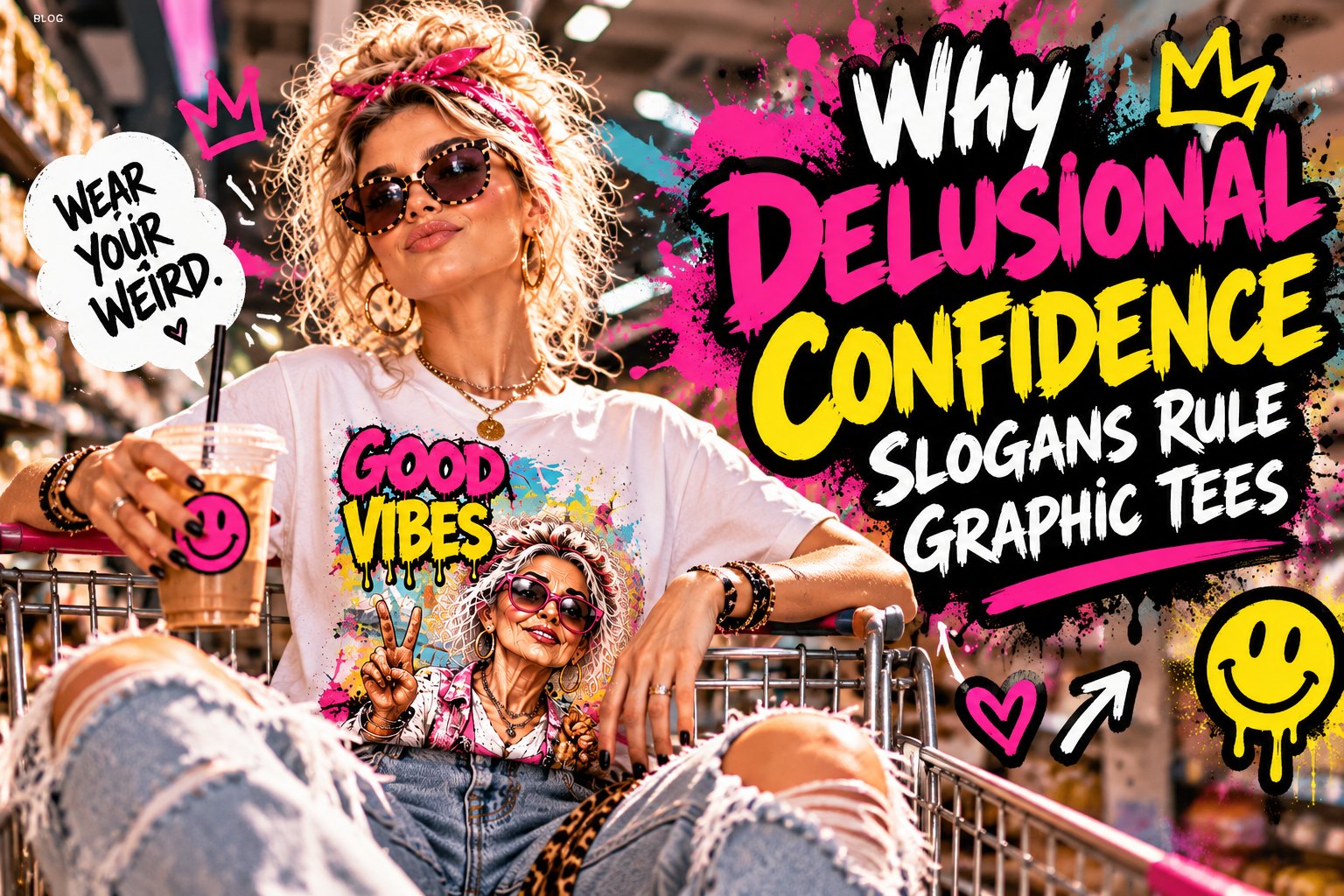
Mundane errands are the natural habitat for ironic slogan t shirts. Fluorescent lighting, squeaky grocery carts, and barcode scanners strip away all pretension by default. When you counter that sterile environment with pure vanity, you create an intentional glitch in the room. You are not actually claiming royalty; you are highlighting how hilariously serious modern life expects everyone to be over a carton of oat milk.
“The theatrical ego only lands when the backdrop is aggressively ordinary.”
Putting on the Too Glam to Give a Damn Shirt for a quick trip to the self-checkout lane turns a routine task into a deadpan character choice. Standing over a malfunctioning scale while an automated voice demands an unexpected item in the bagging area provides the perfect comedic foil. The ridiculousness of the text deflates the petty friction of the chore.
Great streetwear always feeds on dry contradictions. Traditional fashion aesthetics often take themselves so seriously that they tip into self-parody without realizing it. Taking the language of untouchable celebrity and slapping it onto casual cotton flips the hierarchy. You invite onlookers into an obvious private joke where everyone acknowledges that daily life is mostly bureaucracy and sweatpants.
Treating the pharmacy counter like a runway does not make you look conceited; it proves you refuse to let mundane routines sap your sense of humor. The energy is sharp, ridiculous, and completely detached from the quiet gloom of running errands. You give ordinary chores an entertaining edge simply by refusing to dress with appropriate modesty for buying paper towels.
The Fine Line Between Satire and Whining
The line between brilliant irony and second-hand embarrassment comes down to emotional distance. Great comedic arrogance feels completely serene, as if you emerged fully formed from the ether without asking for permission. The joke lands because it refuses to explain itself or acknowledge that an audience exists to dispute the claim. Once you start justifying the swagger, the illusion vanishes.
Trouble starts when text forgets to be ridiculous and begins relitigating personal grievances. The best ironic slogan t shirts operate on absolute, unearned delusion rather than score-settling with real-world rivals. A short phrase celebrating sheer unbothered audacity plays brilliantly across a room. By contrast, a crowded paragraph arguing with unnamed haters sounds genuinely insecure, turning your torso into a comment section nobody asked to read.
Nobody wants to read someone else's unresolved workplace feud or defensive relationship aftermath while waiting in line for coffee. Defensiveness instantly reads as sincere distress, no matter how aggressively the design tries to package it as tough-minded independence. Slogans that warn people about crossing you or crossing boundaries do not sound intimidating. They just suggest you spent the entire weekend replaying an argument in the shower.
- Keep the syllable count low: Two to five punchy words project effortless indifference, whereas multiple clauses read like desperate text receipts.
- Stick to impossible claims: Announcing total supremacy works because the claim is unmistakably absurd on its face.
- Purge the opposition: Cut any phrasing that acknowledges backstabbers, jealous rivals, fake friends, or vindication.
- Adopt cool detachment: The funniest statements sound like bored royal decrees delivered from the backseat of a taxi.
Absurd bravado thrives only when it stays weightless. You want the humor to float cleanly above reality instead of getting dragged into interpersonal muck. Declaring that you run the universe hits with effortless charm because everyone knows you are just carrying laundry detergent across a parking lot. It is funny precisely because there is zero spite behind it.
How to Frame Unearned Bravado in Outfits
The comedic physics of styling ironic slogan t shirts come down to stark contrast. An outrageous boast across the chest requires the rest of an ensemble to behave like a stone-faced straight man in a comedy sketch. If a jacket, trousers, and footwear are all shouting at the identical volume, the deadpan humor dissolves into visual clutter. The gag thrives when the surrounding clothes look completely indifferent to the message stamped in front.
The ideal setup relies on functional, understated workhorses. You want foundational pieces that suggest a quick, thoughtless morning grab rather than twenty minutes of calculated curation. Piling on eccentric patterns or distressed neon accents turns dry wit into a circus routine. When the neighboring garments project quiet utility, the absurd print lands with maximum clarity.
Match an arrogant slogan with dark loose denim, clean retro sneakers, and an unbuttoned overshirt so the phrase occupies center stage. A rugged cotton overshirt acts like an unpolished picture frame around the graphic, neutralizing any suspicion of actual pomposity. Deep indigo denim grounds the lower half, while simple low-profile court shoes keep the whole look tethered to sidewalk reality instead of high-fashion pretension.
Drape and volume make the ultimate difference between crisp irony and clumsy execution. Lean toward relaxed, boxy cuts rather than sharp tailoring or constricting athletic fits. A rigid blazer makes a ridiculous declaration read like an awkward corporate mixer stunt, while skin-tight fabric projects aggressive workout posturing. Slouchy lines communicate total nonchalance, proving that unearned grandeur requires zero physical strain.
Restraint applies to accessories as well. A worn ball cap or a plain canvas grocery tote provides just enough mundane flavor to support the gag. Heavy gold chains, designer badges, or futuristic eyewear ruin the fun because they broadcast genuine social climbing. The entire comedy rests on the canyon between the grandiose message and an ordinary Tuesday spent running basic domestic errands.
Claim absolute dominion, but stay dressed for the parking lot.